
Microsoft Azure runs a large share of enterprise workloads, and in India in particular, many service companies and global capability centres build on Microsoft's cloud. That makes Azure certifications a strong addition to a CV, whether you are a student, a developer, an administrator or a data professional.
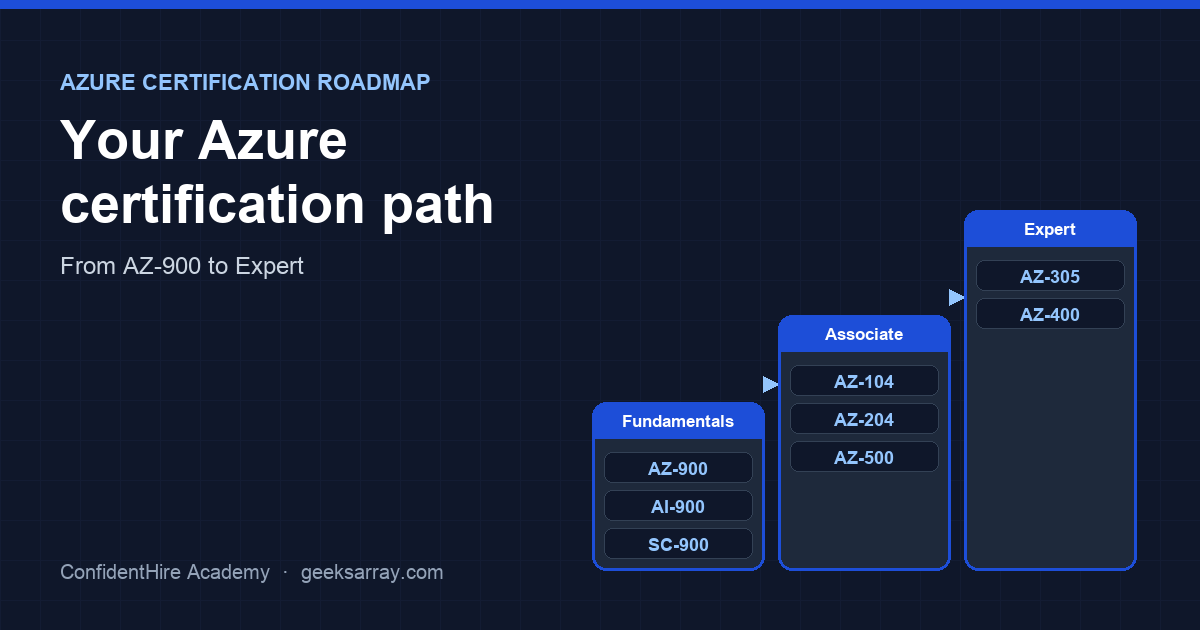
Microsoft's certification catalogue can look confusing at first: there are fundamentals exams, role-based associate and expert certifications, and specialties, with codes like AZ-900, AZ-104 and AZ-305. This guide explains how the Azure certification path is organised, which certification suits which role, and how to prepare for your first one.
How Azure certifications are organised
Microsoft structures its certifications around job roles and levels:
| Level | What it proves | Typical audience |
|---|---|---|
| Fundamentals | You understand core concepts | Students, freshers, non-technical and technical roles new to Azure |
| Associate | You can do a specific job on Azure | Administrators, developers, data and AI engineers, security engineers |
| Expert | You can design or lead at an advanced level | Solutions architects, DevOps engineers |
| Specialty | Deep skill in a narrow technology | Specialists in areas such as SAP or virtual desktops |
Microsoft retires and replaces exams regularly as products change, so always confirm the current exam code and skills outline on Microsoft Learn before you book.
Fundamentals: the best place to start
AZ-900: Microsoft Azure Fundamentals
AZ-900 is the starting point for Azure, and the certification we recommend to most students and freshers. It covers what the cloud is and how Azure works, without requiring you to build or administer anything complex.
The exam is organised into three skill areas:
- Describe cloud concepts (25–30%): cloud models, the shared responsibility model, IaaS, PaaS and SaaS, and the benefits of the cloud such as high availability, scalability and predictability.
- Describe Azure architecture and services (35–40%): regions and availability zones, resource groups, subscriptions and management groups, compute, networking, storage, and identity, access and security.
- Describe Azure management and governance (30–35%): cost management, Azure Policy, resource locks, Microsoft Purview, deployment tools and monitoring.
Format: typically 40 to 60 questions, around 45 minutes of exam time, scored out of 1,000 with 700 needed to pass. Question types include multiple choice, multiple select and statement-based items. You can take it online or at a test centre.
Who should take it: students, freshers, support and testing roles, sales and project teams, and developers or administrators who are new to Azure.
Other fundamentals exams
- AI-900 (Azure AI Fundamentals): AI and machine learning concepts and Azure AI services.
- DP-900 (Azure Data Fundamentals): core data concepts, relational and non-relational data, and analytics on Azure.
- SC-900 (Security, Compliance and Identity Fundamentals): Microsoft Entra ID, security and compliance concepts across Microsoft cloud services.
Fundamentals certifications do not expire, which makes them a low-risk first credential.
Associate: role-based certifications
Associate certifications test whether you can actually do a job on Azure. These are the ones employers most often ask for.
- AZ-104: Azure Administrator Associate. Managing identities, governance, storage, compute, virtual networks and monitoring. The core certification for administrators and the foundation for many other paths.
- AZ-204: Azure Developer Associate. Building and deploying cloud applications: App Service, Azure Functions, storage, security, monitoring and integration with Azure services.
- AZ-500: Azure Security Engineer Associate. Securing identities, networks, compute, storage and data, and managing security operations.
- AZ-700: Azure Network Engineer Associate. Designing and implementing core networking, hybrid connectivity and network security.
- AI-102: Azure AI Engineer Associate. Building solutions with Azure AI services, including language, vision and generative AI.
- DP-300: Azure Database Administrator Associate. Operating Azure SQL and SQL Server on Azure.
- Data engineering: Microsoft has moved its data engineering certification towards Microsoft Fabric (for example DP-700), so check which data exam is current when you plan.
Expert: architecture and DevOps
- AZ-305: Azure Solutions Architect Expert. Designing identity, governance, data storage, business continuity and infrastructure solutions. To earn the expert certification you also need AZ-104.
- AZ-400: DevOps Engineer Expert. Source control, CI/CD, infrastructure as code, monitoring and DevOps processes. It requires either AZ-104 or AZ-204 as well.
Which path fits your role?
| Your goal | A sensible sequence |
|---|---|
| Fresher or student entering IT | AZ-900 → AZ-104 |
| Developer | AZ-900 (optional) → AZ-204 → AZ-400 |
| Administrator or support engineer | AZ-900 → AZ-104 → AZ-305 or AZ-500 |
| Security | SC-900 → AZ-500 |
| Data | DP-900 → DP-300 or the current Fabric data engineering exam |
| AI | AI-900 → AI-102 |
| Aspiring architect | AZ-900 → AZ-104 → AZ-305 |
If you are not sure, AZ-900 is the safest first step: it builds the vocabulary and mental model that every other Azure exam assumes.
Costs, renewal and practical details
- Exam price: Microsoft prices exams by country. AZ-900 and other fundamentals exams cost noticeably less than associate and expert exams, and prices in India are lower than in the US. Check the current price for your country when you schedule.
- Free renewals: associate, expert and specialty certifications are valid for one year, and you renew them for free by passing a short online renewal assessment on Microsoft Learn in the six months before expiry. No second exam fee is needed.
- Fundamentals never expire.
- Discounts: Microsoft runs events such as Virtual Training Days that sometimes include an exam discount, and students can look for academic pricing. These change often, so check Microsoft Learn.
- Free learning paths: Microsoft Learn has free, official learning paths for every exam, many with built-in sandboxes. Use them alongside a course and practice exams.
A practical 8-week plan for AZ-900
AZ-900 needs steady preparation rather than cramming. About eight weeks at 5 to 6 hours a week works well for most beginners:
- Weeks 1–2: cloud concepts. Cloud models, the shared responsibility model, consumption-based pricing, IaaS, PaaS and SaaS, and the benefits of the cloud.
- Weeks 3–4: core architecture and compute. Regions, region pairs and availability zones; resource groups, subscriptions and management groups; virtual machines, scale sets, containers, App Service and Functions.
- Week 5: networking and storage. Virtual networks, VPN Gateway and ExpressRoute; storage accounts, redundancy options, access tiers and data migration tools.
- Week 6: identity and security. Microsoft Entra ID, MFA, Conditional Access, Azure RBAC, Zero Trust, defence in depth and Microsoft Defender for Cloud.
- Week 7: management and governance. Cost Management, the pricing calculator, Azure Policy, resource locks, tags, Microsoft Purview, Azure Advisor, Service Health and Azure Monitor.
- Week 8: practice and review. Full-length timed practice exams, review every mistake, revisit weak areas.
Common mistakes to avoid
- Mixing up similar services: Azure Policy versus RBAC, Azure Advisor versus Azure Monitor versus Service Health, VPN Gateway versus ExpressRoute, LRS versus ZRS versus GRS. Write a one-line comparison for each pair.
- Skipping the governance section. Management and governance is up to a third of the exam, and it is full of specific facts (lock types, policy inheritance, what the pricing calculator does) that are easy marks with preparation.
- Only reading, never clicking. Create a free subscription, set a budget alert, then build a resource group, a small VM, a web app and a storage account. Delete everything afterwards.
- Not reading statements carefully. Statement-based questions often turn on one word such as "always", "only" or "must".
Practise for free on GeeksArray
Our Microsoft Azure Fundamentals (AZ-900) practice exam follows the current skills outline: 50 questions in 45 minutes across the three skill areas, with an estimated score out of 1,000, a breakdown by area and an explanation for every answer. Your first two sittings are free.
Prepare with a live, trainer-led course
Our Microsoft Azure Fundamentals (AZ-900) Certification Prep course starts on 16 November 2026: eight weeks of live online classes, hands-on Azure labs (students can use Azure for Students, with no credit card), a quiz after every module and two full-length practice exams.
Microsoft, Azure and the certification names are trademarks of the Microsoft group of companies. Exam details, prices and renewal rules change from time to time; confirm the current information on Microsoft Learn before you book.
Comments (0)
No comments yet — be the first to share your thoughts.