

Cloud skills now show up in almost every technology job description, from developer and tester roles to support, data and DevOps. Among cloud credentials, AWS certifications are some of the most widely recognised by recruiters in India and abroad. But AWS offers a dozen certifications at four levels, and the most common question we hear from students is simple: where do I start, and what comes next?
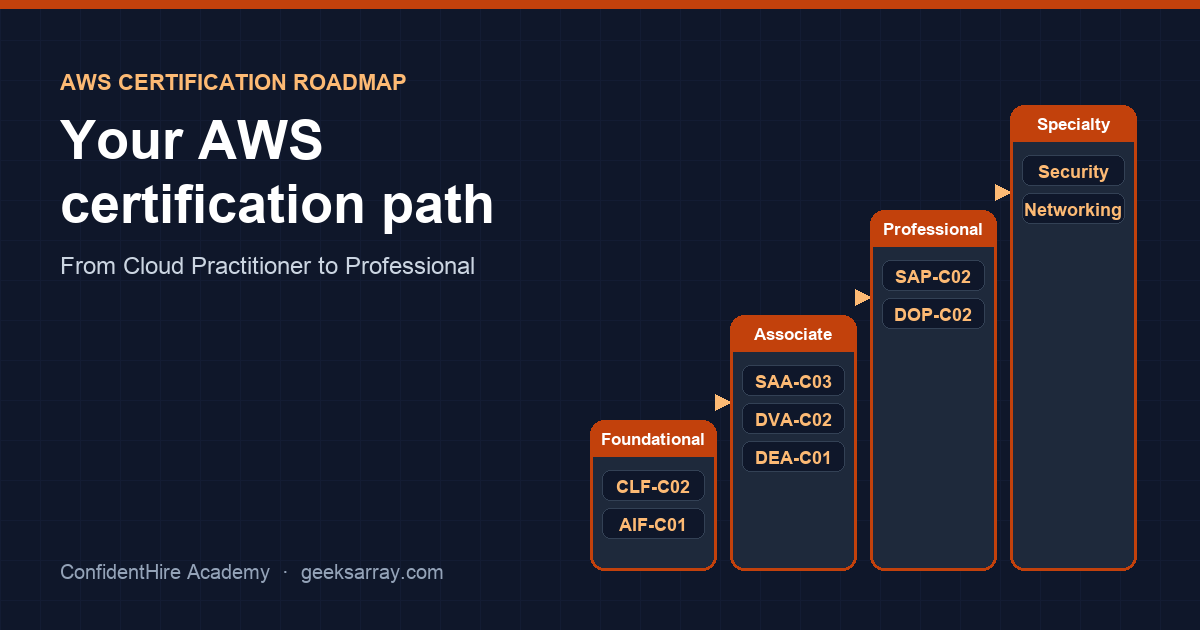
This guide walks through the AWS certification path as it stands today, explains who each certification suits, and gives a practical plan for your first one.
How the AWS certification path is organised
AWS groups its certifications into four levels. You don't have to take them in order (there are no formal prerequisites), but the levels reflect how much hands-on experience AWS expects.
| Level | Who it is for | Typical experience AWS suggests |
|---|---|---|
| Foundational | Anyone new to AWS, technical or not | Around 6 months of exposure to AWS, or a structured course |
| Associate | Builders: developers, administrators, data and ML engineers | Around 1 year of hands-on AWS work |
| Professional | Senior architects and DevOps engineers | Around 2 years of designing and running AWS workloads |
| Specialty | Experts in one domain such as security or networking | Deep experience in that domain |
AWS refreshes its exams every few years and occasionally retires or renames one, so always check the exam code on the official AWS Certification page before you book.
Foundational: where most people should begin
AWS Certified Cloud Practitioner (CLF-C02)
This is the entry point, and the certification we recommend for most students and freshers. It proves that you understand what the cloud is, how AWS is organised and what its main services do, without asking you to build complex systems.
The exam covers four domains:
- Cloud Concepts (24%): benefits of the cloud, the AWS global infrastructure, the Well-Architected Framework, migration strategies and cloud economics.
- Security and Compliance (30%): the shared responsibility model, IAM, security services and compliance tools.
- Cloud Technology and Services (34%): compute, storage, databases, networking, analytics, AI/ML and integration services.
- Billing, Pricing and Support (12%): pricing models, cost management tools and support plans.
Format: 65 questions in 90 minutes, multiple choice and multiple response, scored from 100 to 1,000 with 700 needed to pass. You can take it at a test centre or online with a proctor.
Who should take it: students, freshers, testers, support engineers, project and sales roles, and developers who are new to AWS. If you plan to go further, it is also the easiest way to learn the vocabulary you will need for the Associate exams.
AWS Certified AI Practitioner (AIF-C01)
A newer foundational exam about AI, machine learning and generative AI concepts on AWS, including services such as Amazon Bedrock and SageMaker at a high level. It suits business and technical people who work with AI projects without building models themselves. Many people take it after Cloud Practitioner.
Associate: proving you can build
Associate certifications are where AWS starts to test practical design and implementation skills. Recruiters often treat an Associate certification as the meaningful "cloud" signal on a CV.
- Solutions Architect – Associate (SAA-C03): the most popular AWS certification. It tests designing secure, resilient, high-performing and cost-optimised architectures. Ideal for developers and engineers who want to move towards architecture.
- Developer – Associate (DVA-C02): building, deploying and debugging applications on AWS, with a strong focus on serverless (Lambda, API Gateway, DynamoDB), SDKs and CI/CD.
- CloudOps / SysOps Administrator – Associate: operating workloads on AWS: monitoring, automation, networking and troubleshooting. Suits system administrators and operations engineers. (AWS has been updating and renaming this exam, so check the current code.)
- Data Engineer – Associate (DEA-C01): data ingestion, transformation, storage and pipelines with services such as Glue, Kinesis, Redshift and Athena.
- Machine Learning Engineer – Associate (MLA-C01): preparing data, training, deploying and monitoring ML models, mainly with SageMaker.
Professional and Specialty: going deep
- Solutions Architect – Professional (SAP-C02): complex, multi-account architectures, migrations and cost optimisation at scale. One of the hardest and most respected AWS exams.
- DevOps Engineer – Professional (DOP-C02): CI/CD, infrastructure as code, monitoring, incident response and automation across AWS.
- Security – Specialty: identity, data protection, detection, incident response and infrastructure security.
- Advanced Networking – Specialty (ANS-C01): hybrid networking, Direct Connect, Transit Gateway and network design at scale.
AWS has retired several older specialty exams in recent years, which is another reason to confirm the current list before planning a long path.
Which path fits your role?
| Your goal | A sensible sequence |
|---|---|
| Fresher or student entering IT | Cloud Practitioner → Solutions Architect Associate |
| Developer | Cloud Practitioner (optional) → Developer Associate → Solutions Architect Associate |
| DevOps engineer | Cloud Practitioner → SysOps/CloudOps or Developer Associate → DevOps Engineer Professional |
| System administrator or support | Cloud Practitioner → CloudOps/SysOps Associate |
| Data or analytics | Cloud Practitioner → Data Engineer Associate |
| AI and ML | AI Practitioner → Machine Learning Engineer Associate |
| Aspiring architect | Solutions Architect Associate → Solutions Architect Professional |
If you are unsure, start with Cloud Practitioner. It is the lowest-risk first step, and almost everything you learn carries into the Associate exams.
Costs, validity and practical details
- Exam fees: at the time of writing, foundational exams cost around USD 100, Associate exams around USD 150, and Professional and Specialty exams around USD 300. Local taxes may apply. Check the current price when you register.
- Validity: AWS certifications are valid for three years. You keep them current by passing the latest version of the exam (or a higher-level exam in the same path).
- Discount after passing: when you pass an AWS exam, you receive a benefit that typically includes a discount voucher for your next exam. It is worth planning your next step before that voucher expires.
- Online or at a centre: you can take most exams online with a remote proctor or at a Pearson VUE test centre. For online exams, test your system and room setup a day before.
A practical 8-week plan for Cloud Practitioner
Most learners with no AWS background can be ready for CLF-C02 in about eight weeks of steady study, around 5 to 6 hours a week.
- Weeks 1–2: cloud concepts and the AWS global infrastructure. Learn the benefits of the cloud, Regions and Availability Zones, the Well-Architected Framework and migration strategies.
- Weeks 3–4: security and identity. Master the shared responsibility model and IAM, then the security services (GuardDuty, Inspector, Shield, WAF, KMS) and compliance tools (CloudTrail, Config, Artifact).
- Weeks 5–6: core services. Compute (EC2, Lambda, containers), storage (S3, EBS, EFS), databases (RDS, DynamoDB) and networking (VPC, Route 53, CloudFront).
- Week 7: billing and support. Pricing models, Savings Plans, Cost Explorer, Budgets and the support plans.
- Week 8: practice and review. Take full-length timed practice exams, review every wrong answer, and revisit weak domains.
Two habits make the biggest difference:
- Do hands-on labs. Even a free AWS account and a few guided labs (an IAM setup, an S3 bucket with lifecycle rules, a small VPC) make the services stick far better than reading alone. Always set a budget alert first and clean up after each lab.
- Practise in the exam format. Timed, mixed-domain practice exams expose the gaps you didn't know you had, especially in billing and security.
Common mistakes to avoid
- Memorising service names without understanding them. The exam describes a situation ("a company needs to…") and asks which service fits. Learn what problem each service solves, not just its name.
- Ignoring billing and support. It is only 12% of the exam, but the questions are very specific (which support plan includes a Technical Account Manager, which tool forecasts costs). These are easy marks if you prepare.
- Confusing similar services. CloudTrail versus Config versus CloudWatch, Shield versus WAF, Inspector versus GuardDuty, SQS versus SNS. Make a one-line comparison for each pair.
- Not reading "select TWO" questions carefully. Multiple-response questions need every correct option and nothing else.
- Booking too early or too late. Book when you consistently score well above the pass mark in timed practice, not before; but do book a date, because a deadline keeps your preparation on track.
Practise for free on GeeksArray
We built a full-length AWS Certified Cloud Practitioner practice exam in the CLF-C02 pattern: 65 questions in 90 minutes, mixed across the four domains in the official proportions, with an estimated score out of 1,000, a domain-wise breakdown and an explanation for every answer. Your first two sittings are free.
Take the AWS Cloud Practitioner practice exam
Prepare with a live, trainer-led course
If you would rather prepare with guidance, our AWS Certified Cloud Practitioner (CLF-C02) Certification Prep course starts on 16 November 2026: eight weeks of live online classes (Monday to Thursday mornings plus a longer Saturday session), hands-on AWS labs, a quiz after every module and two full-length practice exams.
AWS and the AWS certification names are trademarks of Amazon.com, Inc. or its affiliates. Exam details change from time to time; confirm the current exam guide, price and format on the official AWS Certification website before you book.
Comments (0)
No comments yet — be the first to share your thoughts.