
TCS CodeVita is one of the largest student coding contests in the world, and Season 14 is open now. For engineering and science students in India it is also something more than a contest: a good CodeVita performance is one of the most visible ways to get noticed by Tata Consultancy Services before campus placements even begin.
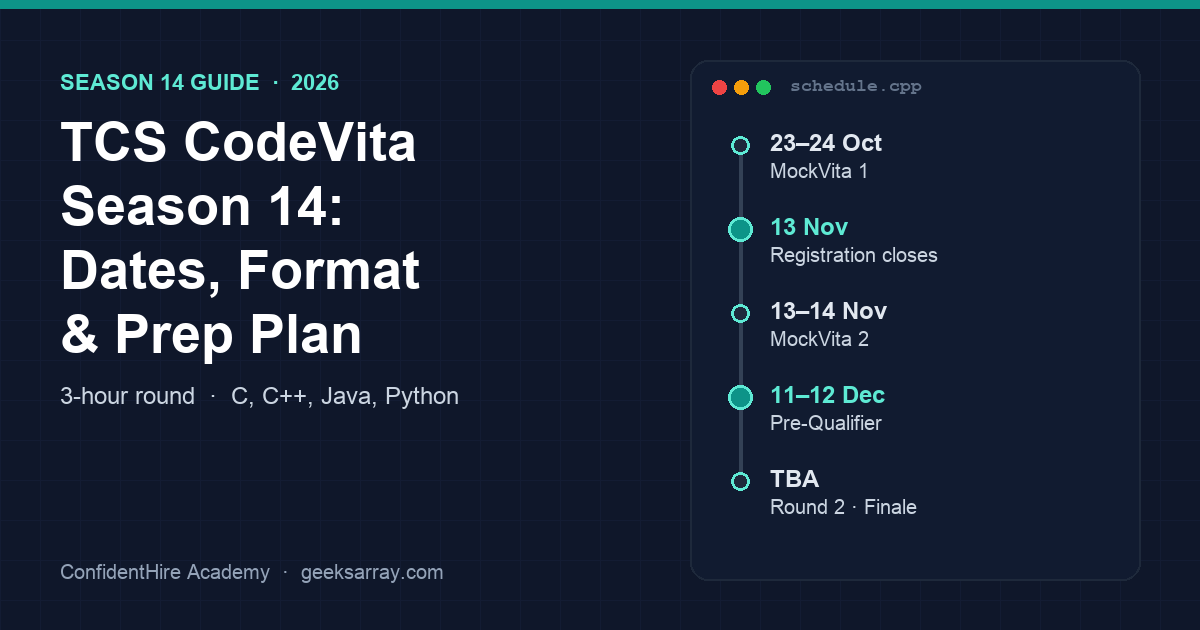
This guide covers everything you need for Season 14: the schedule, who can take part, what the round looks like, how to register and, most importantly, how to prepare in the few weeks that are left.
TCS CodeVita Season 14 at a glance
| Organiser | Tata Consultancy Services (TCS) |
| Who can enter | UG and PG students in science or engineering, graduating in 2027, 2028, 2029 or 2030 |
| Format | Individual, online, multiple rounds |
| Round duration | 3 hours |
| Languages | C, C++, Java or Python only |
| Prize money | US$20,000 in total for the top three coders |
| Registration | Free, on the official CodeVita portal |
| Registration closes | 13 November 2026 |
Season 14 schedule
These are the dates published for Season 14 so far. TCS announces the exact round slots to registered participants, so always confirm them on the official portal and in your registration email.
| Event | Date |
|---|---|
| Registration opens | Open now |
| MockVita 1 (practice round) | 23–24 October 2026 |
| MockVita 2 (practice round) | 13–14 November 2026 |
| Registration closes | 13 November 2026 |
| Pre-Qualifier Round | 11–12 December 2026 |
| Round 2 | To be announced after the pre-qualifier |
| Grand Finale | To be announced |
Two things stand out. First, registration closes on the same day MockVita 2 begins, so do not leave it to the last week. Second, the MockVita rounds are practice rounds run on the real contest platform. Take both. They are the best way to get used to the editor, the input format and the judge before the round that counts.
Who is eligible
Season 14 is open to undergraduate and postgraduate students studying science or engineering at a recognised institution, anywhere in the world, who expect to complete their course in 2027, 2028, 2029 or 2030. That covers most students from the first year of a B.E./B.Tech. to the final year, as well as M.Tech., MCA and M.Sc. students in those batches.
Final-year students graduating in 2026 are outside this season's window.
What the round looks like
CodeVita is not an aptitude test and it is not multiple choice. You get a set of programming problems and a fixed time window, and you write complete programs that solve them.
- 3 hours. Season 14's official page says participants get three hours. You will not have time to solve everything comfortably, so choosing which problems to attempt first matters.
- Story-style problems. CodeVita problems are known for long statements built around a scenario: a train timetable, a factory floor, a game board. Part of the challenge is extracting the actual computational problem from the story.
- Complete programs. You read the input from standard input and print the output exactly as specified. There is no function signature to fill in.
- Hidden test cases. Your program is judged against test cases you cannot see, including large inputs and edge cases. A solution that passes the samples can still fail.
- Four languages. This season allows only C, C++, Java and Python.
- Solve more, go further. The official page puts it simply: solve more questions, advance further. Only the top coders in each round move on, and later rounds may involve technologies beyond traditional programming, with details announced after Round 1.
Why it is worth your time
Beyond the prize money, CodeVita matters for three reasons.
- Visibility with TCS. TCS has used CodeVita performance as a hiring signal in past seasons, and strong performers have received interview opportunities. TCS decides each season's policy, so treat it as a strong advantage rather than a guarantee.
- A global ranking. Top coders receive ranking certificates, which make a concrete line on a resume.
- It is excellent placement practice. The skills CodeVita tests (reading a problem carefully, choosing the right data structure, writing correct code under time pressure) are exactly what campus coding rounds test, including the TCS NQT coding section and the coding rounds of other service and product companies.
Which language should you use?
Use the language you are most fluent in. That said, there are trade-offs.
- C++ is the most popular choice among competitive programmers. It is fast, and the Standard Template Library (vector, map, set, priority_queue, sort) gives you most of the data structures you need.
- Java is a solid choice if you learned it in college. It is fast enough for almost all problems, with a little more typing.
- Python is quickest to write, but it runs slower. On problems with large inputs, an approach that is fine in C++ can time out in Python, so you need fast input and efficient algorithms.
- C works, but you will be writing your own data structures, which costs time in a 3-hour round.
If you have five weeks and are comfortable with basic programming, C++ is worth learning for this contest.
A six-week preparation plan
You have roughly seven weeks before the pre-qualifier. Here is a plan that fits around college.
| Week | Focus |
|---|---|
| 1 | Contest basics: fast input/output, reading long problems, time complexity. Take MockVita 1. |
| 2 | Arrays and strings: prefix sums, two pointers, sliding window, frequency counting. |
| 3 | Sorting, binary search (including binary search on the answer), intervals, simulation problems. Register if you have not. |
| 4 | Maths: GCD, primes and the sieve, modular arithmetic. Take MockVita 2. |
| 5 | Stacks, queues, recursion, backtracking and greedy approaches. |
| 6 | Dynamic programming (1D and 2D) and graphs (BFS, DFS, shortest paths). |
| Final week | Full timed mock contests and a review of every mistake. |
Habits that win contest rounds
- Read the constraints first. If N can be 100,000, an O(N²) solution will time out; you need O(N log N) or better.
- Write down edge cases before coding. Empty input, one element, all elements equal, the largest values allowed.
- Match the output format exactly. An extra space or a missing newline can fail a correct solution.
- Do not get stuck. If a problem is not moving after 30–40 minutes, switch to another and come back.
- Practise under time pressure. Solving problems untimed and solving them against a clock are different skills.
Practise with a free CodeVita-style mock
To help you practise in contest conditions, GeeksArray has a free TCS CodeVita-style mock test. It gives you original story-style problems in a 3-hour round, open book like the real contest, with full programs in C, C++, Java or Python judged against hidden test cases. You get a score for every problem at the end.
The problems are written for GeeksArray and modelled on the contest's style; they are not taken from any real CodeVita paper.
Prepare with a trainer: TCS CodeVita Bootcamp
If you would rather prepare with structure and guidance, ConfidentHire Academy runs the TCS CodeVita Bootcamp with C++ and DSA:
- 28 October to 10 December 2026, finishing just before the pre-qualifier.
- Monday to Thursday, 5:30 to 6:30 PM IST, 26 live online sessions.
- Every topic taught through CodeVita-style problems solved live in C++, from arrays and strings to dynamic programming and graphs.
- Two mock contests reviewed in class and a full 3-hour CodeVita mock before the course ends.
- Fee: ₹5,999.
See the bootcamp details and enrol.
Key takeaways
- Register before 13 November 2026 on the official CodeVita portal.
- Take both MockVita rounds (23–24 October and 13–14 November) to learn the platform.
- The pre-qualifier is on 11–12 December 2026: a 3-hour, multi-problem round in C, C++, Java or Python.
- Prepare by topic, then practise full timed mocks; solving more problems takes you further.
GeeksArray and ConfidentHire Academy are not affiliated with Tata Consultancy Services. TCS CodeVita is a contest run by TCS; for the official rules and dates, see codevita.tcsapps.com.
Comments (0)
No comments yet — be the first to share your thoughts.